Looking Beyond Retreats, and Why Continuity of Life Matters for Enduring Recovery
Retreat-based recovery remains a resonant metaphor in treatment landscapes: the idea of stepping away, pausing, detoxing, resetting.
For many accustomed to pressure, visibility and mobility, the concept carries an appeal – yet it also presents an inherent limitation1-2. After leaving the protective confines of a retreat, for instance, the transition back into everyday life can create the highest risk2-3. Factors such as neuro-behavioural and environmental triggers, unchanged routines, and the return of high responsibility can challenge progress made in self-growth and personal wellbeing; research in substance use disorders records relapse rates in the 40–75% range within six months of post-residential treatment4.
In certain individual situations, the challenge is magnified by global travel, family systems under strain, continuous connectivity, and the relentless expectation of excellence5. A previous piece by Paul Flynn – The Power of Urban Recovery – emphasised the importance of the setting (urban vs retreat) in recovery6. An additional area for exploration is the temporal and relational dimension: what comes after the retreat or intensive phase. Continuity of care, or the seamless bridging between treatment and daily life, becomes foundational in such contexts7.
Revisiting the retreat model: benefits and limitations
Luxury treatment facilities appeal for many reasons: removal from triggers (professional, social, geographic), concentrated therapeutic support, and a temporary escape from the relentless performance demands of everyday life8-10. The intensity and exclusivity of such environments can accelerate early clinical stabilisation and provide a “pause” that some individuals may rarely have the chance to experience10. The immediate effect is often salutary – physical detox, psychological reflection, reset of routine11.
Yet the very nature of the retreat setting can mask a core vulnerability: once the clinical or residential phase ends, an individual may return to stressors, cues, routines, or a lifestyle that can activate certain triggers2. Studies show that relapse rates after inpatient or residential programmes are still very high: for example, one German methamphetamine study found abstinence rates of 25% at 12 months and only 15.7% at 18 months in an intent-to-treat sample12. Another worldwide meta-analysis (incorporating eight databases of both residential and non-residential treatment pathways) reported relapse rates of 40–60% within the first year post-treatment13. Such statistics underscore that withdrawal from the environment alone does not equal transformation of context or resilience6.
For individuals in senior or high-visibility roles, the reintegration terrain can be uniquely complex6. Business obligations resume; family and board roles intersect; travel, global meetings, and hybrid schedules re-activate old routines5. Hidden stressors (such as succession issues, wealth management pressures, or public scrutiny) may return with them. Without deliberate continuity planning, the likelihood of recidivism increases14. Therefore, the intense demands of the individual’s lived experience demand that recovery is not simply away from business and life, but within them.
Neuro-behavioural mechanisms of relapse, in the absence of continuity
Relapse is not merely a matter of willpower or moral resolve; it is a neuro-behavioural process shaped by conditioning, cue-exposure and stress regulation15. Research has long shown that environmental cues associated with substance use or distress episodes can activate the mesolimbic dopamine system, generating craving and relapse even after prolonged abstinence16. Functional MRI studies indicate that exposure to context-linked stimuli – places, objects, or even routines tied to prior behaviour – can elicit dopaminergic responses nearly indistinguishable from active use17.
A probabilistic model of relapse developed by Witkiewitz and Marlatt conceptualises relapse as a dynamic process rather than a single event, emphasising the interaction between situational triggers, affective states, and coping responses18. When environmental contexts remain unchanged, these cues continue to exert predictive power over relapse risk – essentially functioning as conditioned stimuli that reactivate old neural pathways2-4. Work environments, social circles, and stress cues may remain tightly bound to pre-treatment habits, reinforcing conditioned relapse responses despite cognitive insight19.
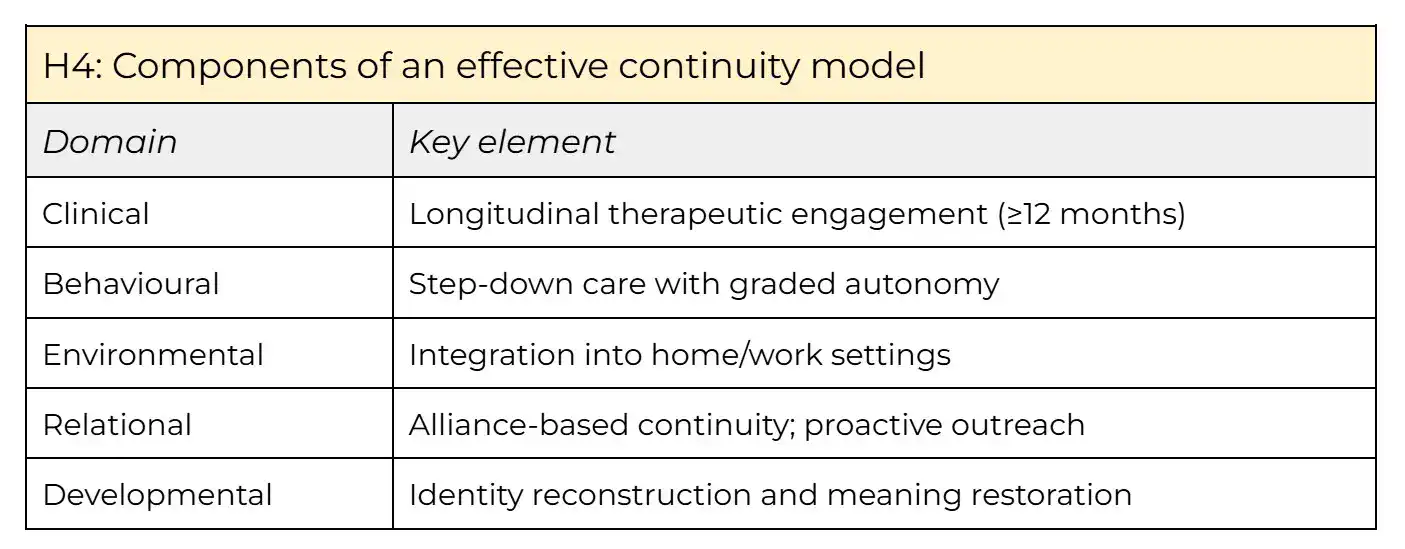
Continuity of care has consistently been shown to mitigate relapse risk: a meta-analysis of 33 continuing-care studies found that interventions extending beyond 12 months were associated with significantly improved abstinence and psychiatric outcomes20. Similarly, a large-scale review of outpatient and step-down programmes published in Psychiatric Services demonstrated that clients who engaged in structured follow-up support for one year or longer were twice as likely to sustain remission compared with those receiving standard aftercare21.
Similarly, a recent longitudinal cohort study showed that ongoing therapeutic engagement predicted reductions in relapse and hospitalisation rates for both addiction and mood disorders22. Together, this evidence base compounds the position that recovery consolidation requires sustained, adaptive contact rather than finite, episodic care6.
Behavioural adaptation and identity reconstruction
Psychological continuity is not only clinical, but also existential in nature20-22. Following intensive treatment, individuals may likely return to the social and occupational identities that previously shaped their behaviours: as a business executive, a leader, a parent, or a public figure, for example23. These identities carry implicit performance scripts – decisiveness, control, self-reliance – that can conflict with the emerging self in recovery24.
When the “recovered” identity is underdeveloped or untested within the lived environment, stress or shame can precipitate regression to prior coping mechanisms25. Effective reintegration, therefore, demands not only symptom management but identity reconstruction: translating therapeutic insight into a sustainable way of being within the same contexts that once perpetuated psychological challenges6.
Continuity of life models – evidence and best practices
1. Phased care and stepping-down models
Contemporary best practice favours phased or “step-down” systems that gradually transition clients from intensive to integrated modes of care26. This model often begins with residential stabilisation, moves through structured outpatient therapy, and culminates in home-based or community-anchored aftercare27. Evidence shows that step-down care enhances self-efficacy and reduces dropout rates, particularly when each phase includes consistent clinical oversight and psychosocial support28. Such frameworks recognise that the neurobiological recalibration of stress and reward circuits continues long after acute treatment ends, necessitating longitudinal scaffolding rather than abrupt discharge26-27.
2. Therapeutic alliances
Sustained therapeutic alliances that accompany clients into their lived environments are central to enduring recovery29. Family-systems approaches – engaging spouses, children, or domestic staff – have been shown to improve relapse prevention outcomes and relationship functioning30.
This alliance may extend to organisational liaison or executive coaching, integrating mental-health literacy and boundary support within the professional ecosystem31. The therapeutic dyad thus evolves from treatment to partnership, guiding the client through the translation of recovery principles into occupational and familial life29.
3. Engagement metrics and structures of continuity
Empirical data highlights the predictive power of engagement itself32. A study of post-discharge addiction patients found that attendance at ≥80% of scheduled aftercare sessions correlated with a 40% reduction in relapse over 18 months33. Engagement quality – defined by therapeutic rapport, consistency, and perceived relevance – was more influential than frequency alone33. Accordingly, continuity programmes emphasise structured follow-up, proactive contact, and adaptive flexibility to maintain relational momentum7.
4. Long-term aftercare and relapse prevention
Sustained remission depends upon both duration and depth of aftercare34. Research in long-term recovery outcomes identifies “time in recovery” and “quality of life variables” – meaning, purpose, social reintegration – as predictors of ongoing wellness35. Another study into sustained recovery found that those engaged in structured aftercare beyond 24 months demonstrated higher emotional regulation and lower relapse probability than short-term completers36.
This highlights that thriving over time in recovery is less about acute symptom relief and more about embedding adaptive habits, supportive networks, and renewed identity across years.
Integrating recovery into everyday life
Sustainable recovery depends not only on what happens in treatment, but on how recovery is lived once treatment ends15-18. True integration means translating therapeutic insight into daily practices – embedding reflection, boundaries, and adaptive coping into the same calendar, workspace, and relationships that once contributed to (or caused) distress. Without that bridge, recovery likely remains an “event” rather than an evolving way of life18.
Effective recovery, therefore, involves designing life around wellbeing rather than forcing wellbeing into an unchanged life6. Far from a “six-week reset” or a “temporary break” from old habits, this entails a commitment to sustainable change – the mental health equivalent of shifting from an aggressive crash diet, to a balanced, lifelong approach to nourishment. This may mean recalibrating professional rhythms, introducing mindful rituals into existing routines, or establishing protective buffers within organisations and family systems, so that wellbeing becomes a maintained state rather than a phase of recovery.
Research consistently shows that when recovery strategies are embedded in real-life contexts (through regular therapy sessions, workplace liaison, or lifestyle redesign) both adherence and wellbeing improve37. Equally important is ongoing therapeutic engagement: check-ins, maintenance sessions, or periodic reviews that nurture mental wellbeing, just as one would maintain physical health through consistent exercise, balanced nutrition, or physiotherapy. Such integration fosters what psychologists describe as “contextual self-regulation”: the ability to adaptively manage one’s internal state within the authentic demands of one’s external environment38. Over time, this transformation shifts the locus of recovery from external support to internalised competence; a state where resilience becomes habitual, not heroic.
Toward a curated continuity philosophy
Ultimately, continuity is more than an extension of care. It is a philosophy of connection, translation, and curation6. In the context of recovery, this involves tailoring clinical, relational, and environmental structures so that the individual’s evolution is both supported and protected across time and context7. Rather than a linear discharge pathway, curated continuity operates as a living ecosystem: adaptive, relational, and responsive to the individual’s shifting realities7.
This philosophy integrates therapeutic presence with lifestyle pragmatism. It extends the alliance beyond the clinical space – into homes, boardrooms, and personal networks – ensuring that recovery principles remain active within the environments that most test them. The curated element lies in its selectivity: identifying which supports, rhythms, and relationships are worth investing energy into, and which must evolve or be released for sustained wellbeing.
In practice, this whole-person approach blends clinical oversight, coaching, and personal stewardship. Trusted practitioners maintain longitudinal awareness of the individual’s journey, offering calibrated input as life’s demands fluctuate.
The result is not dependency, but continuity of intelligence – a shared understanding that recovery is not the absence of struggle, but the ongoing alignment of health, purpose, and identity7. In this view, continuity of care approaches something akin to a philosophy of living: structured enough to sustain progress, flexible enough to accommodate growth, and personal enough to last.